Public D3D7 ProcessVertices point/spot RGB lighting
2026-11-04. Evidence: scratch/runs/20261104-legacy-point-spot-public-lighting/.
The public route repaired by 61802c92d8661f59a8cf0c90a5254a94b0d42e56
also computes the supported point/spot RGB cases below. No production failure
was demonstrated and no production source was changed. The new regression is
test/test-legacy-point-spot-public-lighting.js. It reuses the previous public
x86 COM fixture mechanics, with independently authored literal RGB expectations.
The existing DX7 computed-output alpha authority gap remains open. All 72 positive output alpha bytes are retained but excluded from acceptance. This suite establishes neither a full RGBA contract nor a general rounding rule.
Retained primary rules
Read the previous note and retained DX7 diffuse-reflection, material-source
enumeration and per-vertex-color pages. Read-only HTTPS retrieval followed
their links to these original Microsoft DX7 SDK pages and equation images.
primary/manifest.json records exact URLs, lengths and SHA-256 values;
unaltered response bytes are retained. The equation and spotlight sign images
were visually inspected. Network retrieval is independent of the offline run.
| Primary DX7 page | SHA-256 |
|---|---|
| Light Attenuation Over Distance | c89ebff8b754c2be162da9328273a615b6e92509ed3e7be1b1875e989435136a |
| Attenuation equation | daf3b5290e64f096b3300ee3755d9b5c3b300d7fd92bffd8555d1c8752fb322c |
| Spotlight Falloff Model | 9d3825745d1e24fb343f0f35d5e8fd2dce4eeac99c9edca358e9a849a438e5fe |
| Falloff equation | 72b3ea7830b87d952bc2b981e2dcb9e534b12b3e0ae4f99d540a762a77d13ef1 |
| D3DLIGHT7 | 1001fb12ec17af11e2f0321092e64487b0e95237b931279146eb4490886584a9 |
| D3DLIGHTTYPE | f696a686a9b3faecebc60ee909e4417bf5535aee53f194e4b741628f5f26c359 |

For point/spot lights, distance is d = |light.position - world.vertex|.
When d > range, the light contributes nothing; equality is within range.
Otherwise attenuation is 1 / (a0 + a1*d + a2*d*d). Directional lights
ignore position, range and these coefficients. These cases use positive
denominators and attenuation at most one, avoiding degenerate/clamping rules.
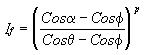
With L the spotlight's outward unit axis and D the unit vector from vertex
to light, the SDK illustration explicitly gives rho = -L dot D. This sign
resolves the text's loose description of the vectors. Let ct=cos(theta/2)
and cp=cos(phi/2): spotlight intensity is zero at/below cp, one at/above
ct, and ((rho-cp)/(ct-cp))^falloff between them. Both angles are total
cone angles, supplied in radians. Distance attenuation multiplies this term.
RGB then follows the previously retained DX7 equation:
Ia*Va + Ve + sum A*(max(0,N dot D)*Vd*Ld + Va*La).
All normals here are unit vectors and the world/view transforms are identity.
Global ambient and emissive are explicitly zero. Independent per-light
diffuse and ambient channels make their attenuation observable separately.
MATERIAL=0, COLOR1=1 and COLOR2=2 select material, vertex diffuse and vertex
specular, respectively; COLORVERTEX and all selectors are explicitly set/read.
Cases and independent arithmetic
The twelve positive states run on each shipped module:
| State | Discriminating geometry/equation | Expected RGB, vertex 0 / 1 / 2 |
|---|---|---|
| Point constant | distances 1,3,9; denominator 3 | (67,67,0) / (67,67,0) / (67,67,0) |
| Point linear | distances 1,3,9; denominator d | (201,201,0) / (67,67,0) / (22,22,0) |
| Point constant + linear | denominator 2+d | (67,67,0) / (40,40,0) / (18,18,0) |
| Point quadratic | distances 1,2,4; denominator 1+2d² | (67,67,0) / (22,22,0) / (6,6,0) |
| Point range | distances 1,3,9; range=3, denominator d | (201,201,0) / (67,67,0) / black |
| Directional | distant position, range=.25, coefficients 3,7,11 ignored | (201,201,0) at all three |
| Point COLOR1 diffuse/COLOR2 ambient | red/green/blue vs green/blue/red source colors | (201,201,0) / black / black |
| Point COLOR2 diffuse/COLOR1 ambient | swapped selectors, same distance attenuation | black / (0,67,0) / (22,0,0) |
| Spot inner/penumbra/outside | axis, 3-4-5 ray, outside ray | (204,186,0) / (102,74,0) / black |
| Spot falloff squared | penumbra intensity 1/4 instead of 1/2 | (204,186,0) / (51,37,0) / black |
| Spot distance × cone | denominator 3, independent green intensity .71 | (68,60,0) / (34,24,0) / black |
| Spot range | range=4 excludes all three distances | black at all three |
Point diffuse red and ambient green intensities are .79: their unattenuated
byte-scale value is 201.45. Spot ambient red is .801 and diffuse green .73;
the distance-times-cone case uses green .71. Inner/outer cosine thresholds
are .9/.7. At (3,0,4), distance=5, rho=.8, diffuse cosine=.8 and cone
intensity=.5 (or .25 for falloff=2). The outside vertex (4,0,2) has
rho=1/sqrt(5), safely below .7. Cone angles are packed to f32 before SetLight.
audit.py independently reconstructs source bytes and the 104-byte D3DLIGHT7
layout, decodes source/destination FVF, and evaluates the RGB equation using
Python Fraction arithmetic. It proves that truncation and nearest-integer
conversion agree for every tested nonzero channel, with at least .04 byte
margin from either interval edge. Float packing/trigonometric error is far
smaller than this margin; the audit separately bounds packed-angle cosine
error below 1e-7. No producer helper, producer output or intermediate producer
color supplies the literal expectations. This does not claim every possible
conversion method is equivalent or establish non-endpoint rounding semantics.
Projection uses w=2z, viewport (3,5,64,32), giving
(35+16x/z, 21-8y/z, .5, 1/(2z)). The audit checks its exact f32 bytes.
During fixture development an outside ray with nonbinary x/z exposed an
arithmetic-order geometry discrepancy, and a combined spot green input exposed
a truncation/nearest ambiguity. Inputs were revised before acceptance.
fixture-development-quantization.json retains the latter input and mismatch;
it is an oracle-development artifact, not a demonstrated producer failure.
Actual public calls and controls
Execution starts with actual x86 DirectDrawCreateEx/QueryInterface, creates
a D3D7 device and vertex buffers, sets/reads matrices, viewport, material,
light, enable and render states, then calls public ProcessVertices and Lock.
No draw, GPU path or host-side replacement computes the actual output.
The fixture supplies the exact shipped Math.cos/Math.pow host imports
used by the Wasm stage; all lighting, attenuation and packing remain in Wasm.
Every input uses LIGHT|TRANSFORM (0x401), flags zero, source index 1,
destination index 2 and count 3. The entire five-record source allocation
remains unchanged, including 0xa5 guards. Six-record destinations keep 0xcd
prefix/suffix records. Geometry is asserted byte-for-byte and only the three
RGB bytes in each written color are accepted. Descriptor and Set-input
immutability, guarded output pointers, capacities, HRESULTs, stdcall cleanup,
caller RET, bounded completion and stack canaries are checked. Zero-count,
source-end, destination-end and null-source calls check HRESULTs and complete
destination immutability through fresh public Lock/Unlock.
Totals for positives: 24 allocations, 72 vertices, 216 RGB bytes, 2,808 checked destination bytes, 96 guard ProcessVertices calls and 1,124 stack-checked public calls. The independent audit verifies these counts.
Seventeen controls per module change one decisive state: point/directional type, position, range, constant/linear/quadratic coefficient, spot direction, theta, phi, falloff, spot/point type, diffuse/ambient material source, diffuse/ambient light intensity, enable, and spot range. All 34 controls successfully set/read state and complete ProcessVertices, retain the original RGB table, and fail it. RGB failure is deferred until after source, geometry, destination guards and Unlock/Release checks, so controls exercise those too.
Verification, identities and remaining boundary
Focused evidence run, ordinary no-evidence invocation, independent audit,
previous supported-computed-lighting regression, D3D7 FVF lighting,
ProcessVertices dimensional regression and ProcessVertices fog regression all
pass. flock /tmp/wine-build.lock bash tools/build.sh passes. The test uses
the ordinary default test tier and needs no evidence environment variable.
Starting recorded Git identity: de6a33f257d93e8814d666bdec62361161569ac4;
validation head: d17c8d23c59e7efbcf7fd16226065758ab962d9a (peer docs only).
Original and current modules are identical across the serialized build:
| Existing path | Original/current SHA-256 |
|---|---|
build/wine-assembly.wasm |
4417305d70322467441aef51e888b0fe66451d9c60da0c734eeb23f5a22c0a6b |
build/wine-assembly.compat.wasm |
07fb4e75d05177271097dcd67d84e2629272b50073074bbdea8825ce10b4ed34 |
test/binaries/calc.exe |
cb71fcc9726f756421519a215c39cf89efd930c9ae0fa5bbb59b64050faef52b |
identities.json, relevant binary diff, owned new-file patches, dependency
hashes, primary manifests, test logs and SHA256SUMS retain recovery evidence.
Git remains the source archive. No source-tree snapshots or module/media
copies were made. No peer guest-worker, cache-observer or tools file was edited.
Remaining boundary: explicit primary DX7 computed-output alpha and its material-source interaction are still needed before a full RGBA oracle. Specular lighting, degenerate light configurations, arbitrary conversion, nonrigid normals, native Windows/GPU parity, 27-app coverage and gameplay remain unproved. No Chrome, game, boat allocation, subworker, deployment or runtime lifecycle operation was performed. Assigned box ID/state/expiry: NA. The coordinator retains ownership of future runtime work and shutdown.